
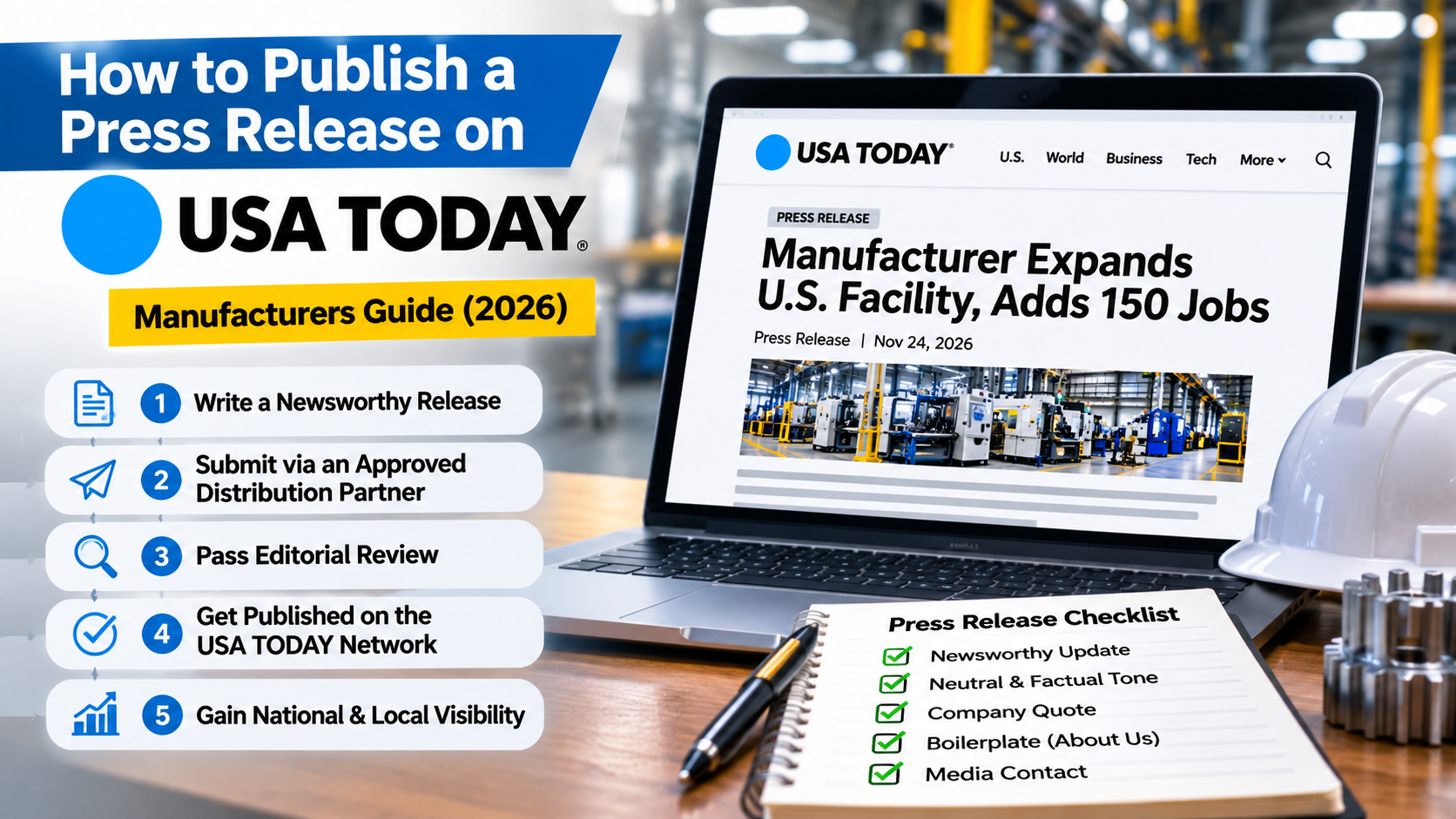

A few years ago, a mid-sized manufacturer had two ways to get its name onto USA TODAY. It could earn a reporter’s attention or buy an ad. Neither works for a plant expansion in Ohio or a new hydraulic press line.
That changed in June 2025. Gannett announced an agreement with XPR Media to distribute press releases across the USA TODAY Network of more than 200 publications, with a dedicated press release section. Gannett has since become USA TODAY Co. For industrial companies, that means a well-written release can now sit on the USA TODAY site and on local Gannett papers in the towns where you build, hire and sell.
I run a press release distribution business and publish FastMR, so I see both sides: the releases that go live and the ones that come back rejected. Industrial releases get rejected for reasons that are easy to fix once you know them. Here’s what I’ve learned.
What a USA TODAY press release is, and what it isn’t
A release on the USA TODAY Network is a labeled press release. It is not a news story written by a USA TODAY journalist.
That difference matters for how you describe it. “Published on the USA TODAY Network” or “distributed through the USA TODAY Network” is accurate. “Covered by USA TODAY” or “as seen in USA TODAY” isn’t, and sophisticated buyers notice.
It also matters for SEO. Treat any links in the release as nofollow unless you’ve checked the live page yourself. If backlinks are your only goal, this is the wrong product.
What you do get is a page on a recognized national domain, local-market visibility through network papers, and a credible link you can put in a sales deck or a distributor email.
Which industrial announcements actually get accepted
Every release goes through an editorial review before it publishes. Reviewers want a verifiable development, written in neutral third-person language. In my experience, these industrial topics pass most reliably:
- Plant openings, expansions and relocations, with location, square footage and jobs created
- New product lines, described by what they do, not by how good they are
- Certifications and compliance milestones: ISO, UL, AS9100, CE, or a new OSHA safety record
- Contract awards and supplier agreements, if the other party agrees to be named
- Acquisitions, mergers and new distribution partners
- Leadership appointments, with a real quote from the new hire or the CEO
- Workforce programs: apprenticeships, training centers, partnerships with local colleges
The local angle is your advantage. A new facility in Knoxville is news to Knoxville readers. Lead with the place.
Why industrial releases get rejected
Most rejections I see from manufacturers come down to one habit: writing the release like a brochure. Reviewers classify each submission as either a press release or an advertorial, and advertorial copy doesn’t publish.
The usual triggers:
- Spec-sheet marketing. “Industry-leading,” “best-in-class” and “unmatched precision” read as advertising. State the tolerance, the throughput or the load rating instead.
- Unverifiable performance claims. “Cuts energy costs by 40%” needs a source: a test standard, a customer pilot or a third-party report. If you can’t cite it, cut it.
- Calls to action. “Request a quote,” “contact our sales team” or “visit our booth” will sink the release. The media contact block at the end is enough.
- Pricing and promotions. Launch discounts and dealer incentives belong in your sales emails.
- A weak or missing boilerplate. Thin “About the company” sections cause more rejections than most writers expect. Give the founding year, headquarters, what you make and who you serve.
- No quote. A release without a named spokesperson quote loses heavily in review.
- Image problems. Only use photos you own the rights to. Stock images of machinery you didn’t build are a risk.
How long it takes
Once a release passes review, it usually goes live within hours, not weeks. Revisions add time. If a reviewer flags a claim, you’ll rewrite and resubmit.
If the announcement is tied to a date, such as a ribbon cutting, a trade show or an earnings call, submit a few days early. Local Gannett papers that take event listings often ask for much more lead time.
A structure that works for manufacturers
Aim for 500 to 1,000 words. Releases much shorter than that tend to score poorly; much longer ones lose readability.
- Headline: the development in plain words. “Acme Gearworks Opens 120,000-Square-Foot Plant in Greenville, Adding 85 Jobs”
- Dateline: CITY, State, Month Day, Year
- First paragraph: who, what, where, when, in two or three sentences
- Second paragraph: the numbers. Capacity, investment, jobs, certifications, timelines
- Quote: one named executive, saying something a reporter would quote. Skip the “we’re thrilled” lines
- Context: why it matters for customers, the local economy or the supply chain. Keep it factual
- Second quote (optional): a customer, partner, economic development official or union rep
- Boilerplate: founding year, HQ, products, markets, certifications
- Media contact: name, title, email and phone
One contextual link to your site is plenty. Several promotional links make the release look like an ad.
Is it worth it for an industrial company?
It depends on what you need it to do.
It’s worth it if you want a credible third-party page to point buyers, distributors and recruiters to, or if local visibility near a facility matters. It also helps when you need something searchable for your brand name after a big milestone.
It isn’t the right tool if you’re hoping for a reporter to call you, or if your announcement isn’t really news. A release can’t turn a product brochure into a story. For editorial coverage, pitch trade journalists directly, and use the release as the official record you link them to.
If you want the mechanics of submitting through a distribution service, including requirements and cost, I’ve written a separate guide on how to publish a USA TODAY press release at TS Newswire, which I run.
FAQ
Can a manufacturer publish a press release on USA TODAY?
Yes. Since June 2025, approved press releases can run in a dedicated press release section on USA TODAY and across the USA TODAY Network. Each release goes through editorial review first.
Is a USA TODAY press release the same as being covered by USA TODAY?
No. It is a labeled press release, not a story by a USA TODAY journalist. Describe it as “published on the USA TODAY Network,” not “covered by” or “featured in” USA TODAY.
What gets an industrial press release rejected?
The most common reasons are marketing language, unverifiable performance claims, calls to action, pricing or promotions, missing quotes and a weak company boilerplate.
How long does it take to go live?
An approved release usually goes live within hours. Revisions requested in review add time, so submit date-tied announcements a few days early.
How long should a manufacturing press release be?
About 500 to 1,000 words, with a dateline, at least one named quote, a boilerplate and a media contact.
Do USA TODAY press releases give dofollow backlinks?
Don’t count on it. Treat links as nofollow unless you’ve checked the live page. The value is credibility and visibility, not link equity.
Disclosure: Vivek Sharma is the founder of TS Newswire, a press release distribution service. USA TODAY is a trademark of its owner. FastMR and TS Newswire are not affiliated with or endorsed by USA TODAY Co. A press release published on the USA TODAY Network is not editorial coverage by USA TODAY.
